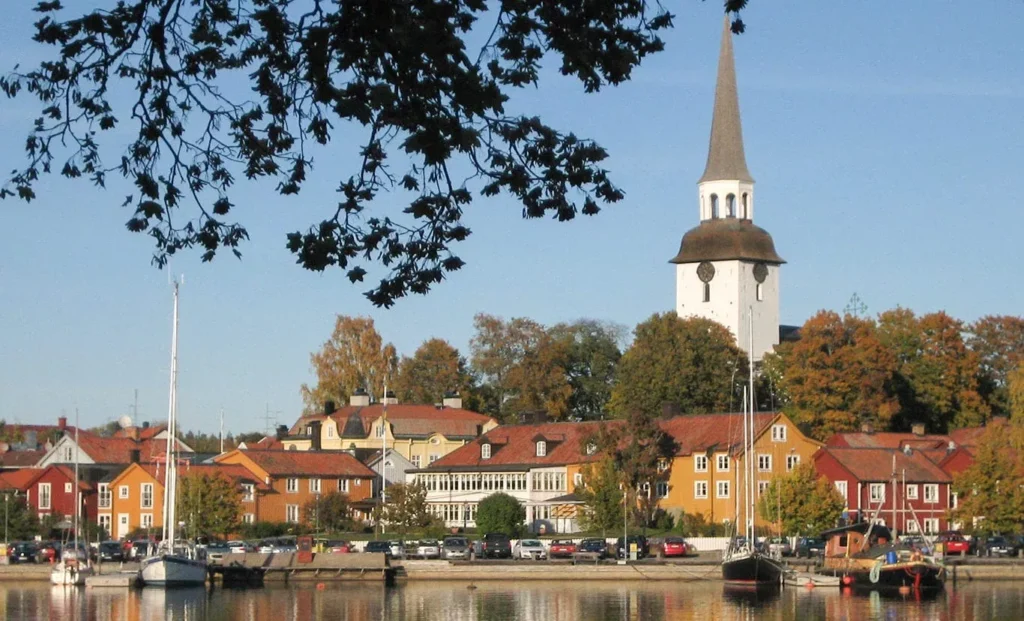
Sweden's first värdshus
At the beginning of the 17th century, Mariefred had no coaching inn, inn or värdshus, as it was the burghers of the town who were obliged to provide the travelers with accommodation and food. When the traveler was employed by the court, the bourgeoisie were not paid for their hospitality, but the services were considered a form of tax. As Charles IX was often at Gripsholm Castle, it became costly for the city's burghers to house and feed all the court employees. Wild protests erupted in 1609 against the conditions and on February 13, 1609, a letter of privilege was issued to the first innkeeper in Mariefred, Jocim Smock from Germany, who had previously run a tavern in Stockholm. The Smock Room in the inn is named after him, the first in a long line of innkeepers over the centuries.
Extensive renovations
In 1987, extensive renovation of the inn began. During the excavations, the foundations of the Carthusian monastery Pax Mariae, Mary's peace, which gave its name to the town of Mariefred, were found under the basement floor. This was considered sensational, as it was previously thought that the church, now located next to the inn, was built on the walls of the monastery.
The Swedish National Heritage Board began excavations to map the monastery walls and the renovation was delayed by a year. Construction of the monastery began in the 1490s and was demolished in connection with the construction of Gripsholm Castle in 1537 under Gustav Vasa.
Some of the finds were used to furnish the inn. Two monastery wells and a mill wheel, which are now in the wine cellar, were found along the walls. The ceiling of the Smock Room is made of piles found in the blue clay under the inn. The piles were split, dried and preserved. The National Heritage Board dated the piles and concluded that they were felled during the winter of 1507.
In 1989, Gripsholm Värdshus was reopened after careful renovation and extension. The old main building from the 1750s was extended by 12 meters and houses two of the royal suites. The parquet floors are designed after originals from Swedish castles and manor houses.
Throughout the construction work, three artists have made the decorations on the walls in all guest rooms, conference rooms and on the ceiling in the reception. The symbols in the hand-forged staircase railing from the Smockska Room and the inlays in the parquet floor show different eras of Mariefred's history.
The history of Mariefred and Gripholm Castle
Twelve-hundred-year-old trading post
The oldest remains on Slottsholmen date from the 8th century AD and consist of a sacrificial site, where the people of the time worshipped their pagan gods. From the 11th century, the remains of a dwelling house and a number of rune stones have been found, which tell of journeys to modern-day Turkey, the interior of Russia and Iceland. Finds of beads testify to trade links with India. These were probably obtained as payment in Miklagård - today Istanbul - for sold furs, skins, iron and amber.
Farmers destroyed the first castle
The king of Sweden - the treasurer or today's finance minister - Bo Jonsson Grip had a richly decorated castle built on Slottsholmen, which was inaugurated in 1380. When Grip died six years later, the castle was stormed by disgruntled and "exploited" peasants, destroyed and left in ruins.
Carthusian Monastery
In 1490, two Carthusian monks visited Bishop Rogge in Strängnäs and asked for land to build a monastery. The bishop turned to Sten Sture the Younger, who donated the land around the hill where the church is located today. The monastery was built in 1493. The Carthusian monks had taken a vow of silence, which could only be broken at Sunday mass. The monks were highly skilled in the medicinal arts of the time, cultivating healing herbs and producing curative herbal oils. Each monk had his own cell and a quilt to look after. To avoid meeting at the monastery's communal well, each monk dug his own well, thus avoiding the temptation of accidentally speaking to one of the other monks and breaking the prescribed silence.
Gustav Vasa becomes king
On June 6, 1523, Gustav Vasa was elected King of Sweden in Strängnäs Cathedral, a date we celebrate today as Sweden's National Day. Gustav Vasa came to power after a bloody war of liberation against the Danes led by Christian II, Christian the Tyrant. The king promised to build up a Swedish military force, to create Swedish legislation and to give the nobility back their privileges and power, which required large sums of money.
New castle of old monastery
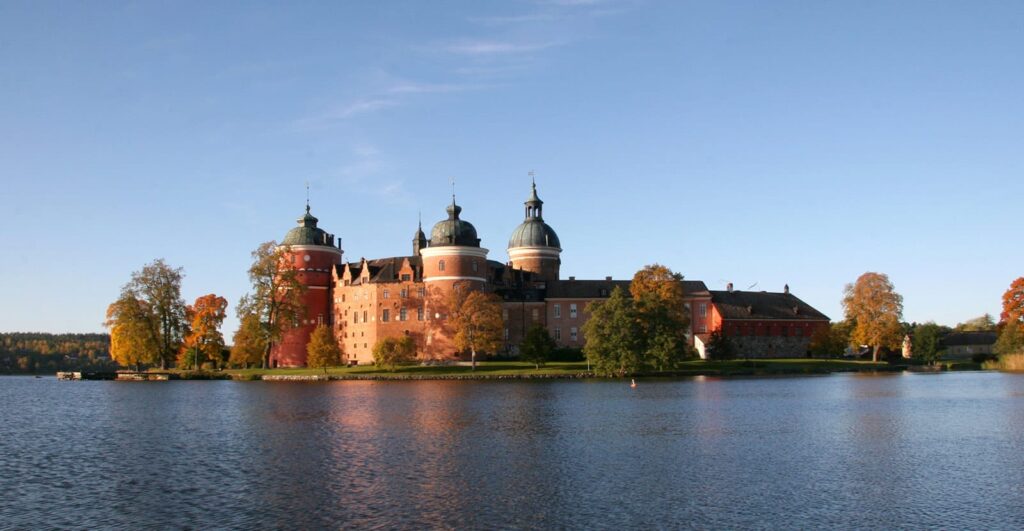
The Catholic Church had long been the strongest economic power in the country. Gustav Vasa, who had heard about the German Martin Luther and his Reformation teachings, decided to reform Sweden by becoming the head of the Church himself and thus being able to dispose of the Church's enormous assets. Catholicism was banned, monks and nuns were driven out of the country and all monasteries, including the Carthusian monastery in Mariefred, were razed to the ground. In Mariefred, the monastery's old building blocks were used to build a defensive castle on Slottsholmen. The castle was completed in 1547 with its four round towers, then equipped with cannons, as well as the buildings connecting the towers, and was intended to defend the important shipping port, especially for iron from Åkers Bergslag.
More prison than castle
However, Vasaborgen, which we know today as Gripsholm Castle, was never used for defense purposes, but was primarily used as a prison for the sons of Gustav Vasa. Erik XIV, who inherited power from his father Gustav, felt persecuted by his younger brother Johan III, who was sitting on a fief in Finland. Johan and his wife Katarina Jagellonica were imprisoned and ended up as prisoners at Gripsholm Castle. During his imprisonment, Prince Sigismund was born. After holding his brother's family for six years, Erik XIV no longer felt threatened and released the family. The result was a swift coup d'état, with the roles reversed - Erik was imprisoned and Johan became king. Erik XIV was moved around dungeons in different castles in the country until he finally ended up at Örbyhus Castle in Uppland, where he was served arsenic-poisoned pea soup and died.
Castles with central heating
Several family feuds followed and finally the third son of the Vasa came to power, the Duke of Södermanland, Karl IX. He grew up at Räfsnäs Gård outside Mariefred and was therefore familiar with the area. Charles IX realized the potential of Gripsholm Castle and was the one who transformed the old Vasa Castle into a castle. He let light into the rooms by inserting carpets in the walls, moving up the bulkhead doors, inserting real windows and he also built a kind of central heating system for the entire castle. Thanks to the renovated castle, the community also revived and the village outside the castle began to grow. In 1605, city privileges were obtained and the city was named Mariefred after the Carthusian monastery that once stood here - Pax Mariae, Mary's Peace.
From prison to the Queen Dowager's residence
Gripsholm Castle never became a seat of government, but has mainly served as a seat for widowed queens who were often banished to the provinces so as not to disrupt politics in Stockholm. For example, Gustav II Adolf's wife, Maria Eleonora of Brandenburg, sat here when her husband was fighting in Germany. After the king's death in Lützen in 1632, the guardianship government did not want the disliked queen and her daughter in Stockholm, and they were banished to live at Gripsholm Castle. Maria Eleonora loved her husband so much that she preserved his heart in a silver box that she took with her on her flight from the country. However, she left her 14-year-old daughter Kristina behind.
Unique castle theater
King Gustav III was extremely proud of his Vasa origins. He loved to live in fantasy, and what better place to do so than the fantastic Vasa castle of Gripsholm Castle? King Gustav III celebrated many Christmases at the castle. The entire court and a theater company were always in the king's entourage at Gripsholm Castle. A theater was built in one of the towers, which looks the same today as it did in 1792 when the fateful shot that killed Gustav III was fired at the Opera in Stockholm. Today, the theater is only used once a year for a concert and then only the orchestra pit is used, not the stage itself. Everything is preserved in its original state at the Slottsteatern - scenery, machinery and decorations.
Too ugly ladies according to Bellman
King Gustav III was very fond of Carl Michael Bellman, who often stayed in Mariefred at the king's invitation. However, Bellman thought that the town was too provincial, the ladies too ugly and the castle too outdated. At that time Mariefred had 14 taverns for about the same population as today (about 5,000). Today the town has three taverns.